

In the context of the Geneva Trialogue, the European research project Crowd4SDG held a hybrid workshop on March 17th called “Closing the gap between institutions and citizen science generated data and solutions”.
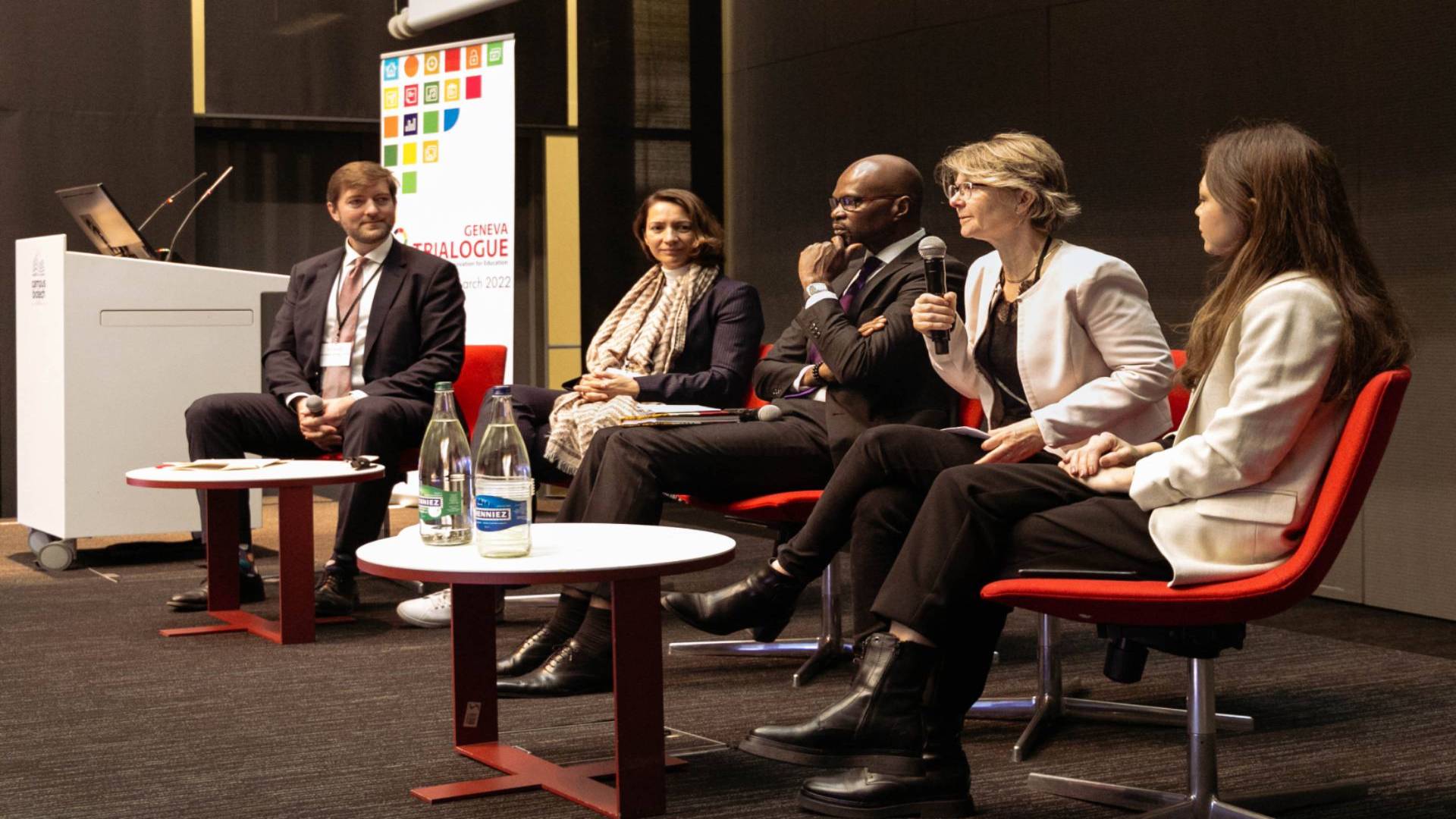
© Geneva Trialogue
During the Geneva Trialogue conference, the Crowd4SDG project, which Université Paris Cité is a partner, gathered institutional members, associated partners and finalists of the “WOMER”, “DONATE WATER” youth led projects. The round tables were moderated by Stephanie Chuah, programme manager at the University of Geneva and Camille Masselot, research project coordinator at Learning Planet Institute.
The group gave an update on the progress of the Crowd4SDG project, emphasizing its mission: to launch youth-led crowdsourcing projects that track progress towards the SDGs and generate local innovations for the SDGs. Participants brainstormed to identify the gaps between institutional data and data generated by citizen science. They discussed how the gaps can be bridged by sharing knowledge, creating synergies and potential partnerships, particularly in the field of water and sanitation.
A community mobilized around climate issues and gender inequalities
The two finalists “WOMER” and “DONATE WATER” shared their observations on the challenges and opportunities they faced while implementing their projects. The group as a whole identified some topics that needs to be tackled, notably around:
- Aligning SDG methodologies with how data is collected.
- Reliability of citizen science data built from scratch versus existing data.
- Institutional resistance to data quality, design and other forms of implementation.
- Linkages between NSOs and citizen science initiatives.
The GEAR Cycle
Initiatives organised by Crowd4SDG follow a robust innovation cycle called GEAR (gather, evaluate, accelerate, refine) over six months for each period. The first GEAR cycle began with an online screening and coaching of citizen-generated ideas for climate action and water in the fall of 2020. The second cycle started as of August 2021 aims to tackle climate and gender issues. Five teams completed a challenge-based innovation workshop hosted by IdeaSquare at CERN. The Geneva Trialogue marked the end of the second GEAR cycle where the two finalists presented their projects. Members are preparing for the final cycle, which will begin in the coming months.
About
The Crowd4SDG consortium (UNIGE, CERN, CSIC, IIIA, Politecnico di Milano, UNITAR, Universite Paris Cité and Learning Planet Institute (formerly CRI) promotes citizen science aimed at the SDGs, focusing on Climate Action. The goal of this EU funded project is to assess the usefulness of practical innovations developed by the teams, and research and investigate how AI applications can enhance and provide effective monitoring of SDG targets and indicators by citizens.
Read more

Phages, Towards a Targeted Alternative to Antibiotics
With the rapid development of antibiotics in the 1930s, phage therapy – using viruses known as bacteriophages or phages to tackle bacterial infections – fell into oblivion. But as the current rise in antibiotic resistance is making it increasingly difficult to treat...
![[Circle U.] Apply for the 2025 winter schools](https://wordpress-test.app.u-pariscite.fr/wp-content/uploads/2024/11/ECOLE-DHIVER-1080x675.jpg)
[Circle U.] Apply for the 2025 winter schools
Would you like to spend a few days in Europe as part of your studies? The Circle U. European Alliance is organising two winter schools on the themes of sustainable oenology and artificial intelligence. Find out how to apply! Sustainable “WINE” Intensive week from the...

Highly Cited Researchers 2024: 26 citations for Université Paris Cité
Clarivate has released the list of 126 scientists whose first affiliation is with a research institution based in France and who are featured in the 2024 ranking of the 6,886 most highly cited researchers. With 26 first-affiliation mentions, Université Paris Cité has...

Looking back at The Guild conference: Artificial Intelligence in Higher Education and Research
On November 6th 2024, Université Paris Cité and Université PSL brought together the communities of The Guild of European Research-Intensive Universities for an event about artificial intelligence and its impact on universities, at the PariSanté Campus. Stéphanie...